By Thomas Abidoye

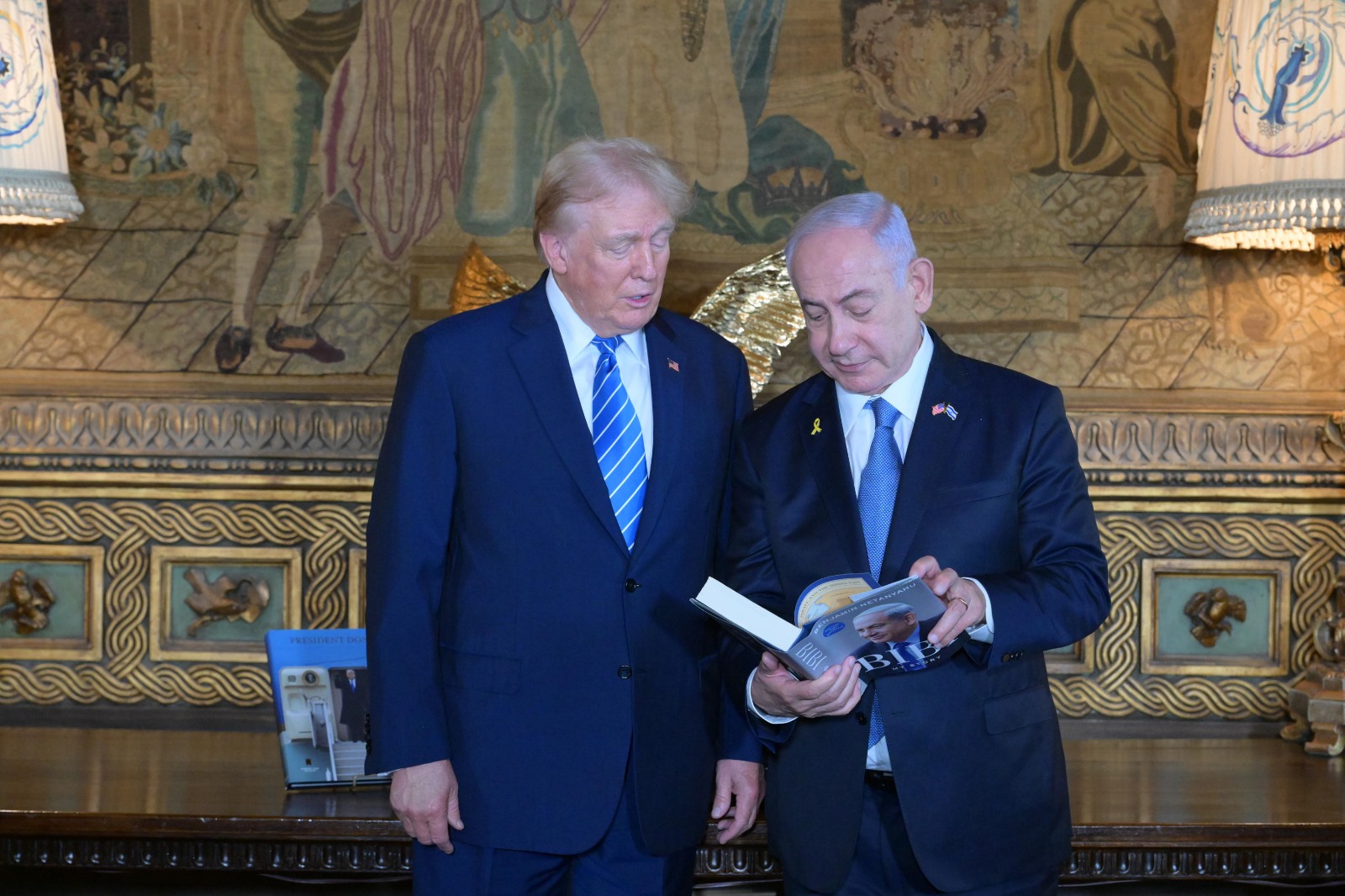
Trump – Israeli Prime Minister Benjamin Netanyahu has commended United States President Donald Trump, referring to him as a resolute leader and stating that the global community benefits from his position in power.
During comments made on Monday regarding heightened conflicts with Iran, Netanyahu asserted that no previous president compares to Donald J. Trump, highlighting what he views as Trump’s determination, straightforwardness, and readiness to implement firm measures.
Netanyahu explained that Trump eliminates unnecessary distractions and prioritizes essential actions.
He further noted that Israel and nations in what he termed the free world are privileged to experience Trump’s guidance, attributing to him the revival of America’s prominent role internationally.
Netanyahu added that for Israel, for the countries of the free world, and indeed for the entire world, they are very fortunate to have Trump as the leader of the free world and in fact the leader of the world, as he has restored America to its position as the world’s leader.
In discussing the rationale behind the latest military action against Iran, Netanyahu charged the Iranian administration with enduring animosity toward the United States.
He claimed that Iran has engaged in decades of anti-American propaganda and has been linked to assaults on US diplomatic facilities as well as attempts to harm American officials.
Netanyahu also portrayed Iran as a government that disseminates terrorism worldwide and remains dedicated to weakening the United States.
Background of the Ongoing US-Israel War Against Iran
Tensions between the United States, Israel, and Iran have roots dating back to the 1979 Iranian Revolution, which overthrew the US-backed Shah and established the Islamic Republic under Ayatollah Khomeini.
This event led to severed diplomatic ties, with Iran viewing the US as the “Great Satan” and Israel as the “Little Satan.”
Key early flashpoints included the 1979-1981 US Embassy hostage crisis in Tehran and Iran’s support for groups like Hezbollah, which conducted attacks such as the 1983 Beirut barracks bombing that killed 241 US service members.
In the 2000s, concerns escalated over Iran’s nuclear program, which Western nations suspected aimed at developing weapons, despite Tehran’s claims of peaceful intent.
The US and Israel imposed sanctions, conducted cyber operations like the Stuxnet virus in 2010 that disrupted Iranian centrifuges, and carried out targeted assassinations, including that of nuclear scientist Mohsen Fakhrizadeh in 2020.
Israel has long advocated for military action to prevent Iran from acquiring nuclear capabilities.
Proxy conflicts have intensified the rivalry. Iran backs militias in Iraq, Syria, Yemen (Houthis), and Lebanon (Hezbollah), leading to indirect confrontations.
The US withdrawal from the 2015 Joint Comprehensive Plan of Action (JCPOA) nuclear deal under President Trump in 2018, followed by “maximum pressure” sanctions, heightened hostilities.
Iran responded by enriching uranium beyond deal limits and attacking oil tankers in the Strait of Hormuz.Direct military escalations began in 2020 with the US drone strike killing Iranian General Qasem Soleimani in Baghdad, prompting Iranian missile strikes on US bases in Iraq.
Israel has conducted hundreds of airstrikes on Iranian-linked targets in Syria since 2011 to curb arms transfers to Hezbollah.By 2025-2026, the conflict evolved into open warfare following alleged Iranian-backed attacks on Israeli territory and US assets, including drone strikes on Saudi oil facilities and shipping disruptions in the Red Sea.
A major trigger was Iran’s advancement in hypersonic missile technology and ballistic missile tests, prompting joint US-Israeli preemptive strikes on Iranian nuclear sites like Natanz and Fordow in late 2025.
This led to Iranian retaliatory missile barrages on Israeli cities and US bases in the region.The ongoing war involves US-Israeli airstrikes on Iranian military installations, naval blockades in the Persian Gulf, and cyber warfare.
Iran has mobilized proxies for ground assaults in Syria and Iraq, resulting in thousands of casualties. International involvement includes Russia and China providing diplomatic support to Iran, while European nations urge de-escalation.
As of March 2026, no formal peace talks have occurred, with the conflict exacerbating global energy prices and regional instability.
https://x.com/i/status/2028657009608851485