
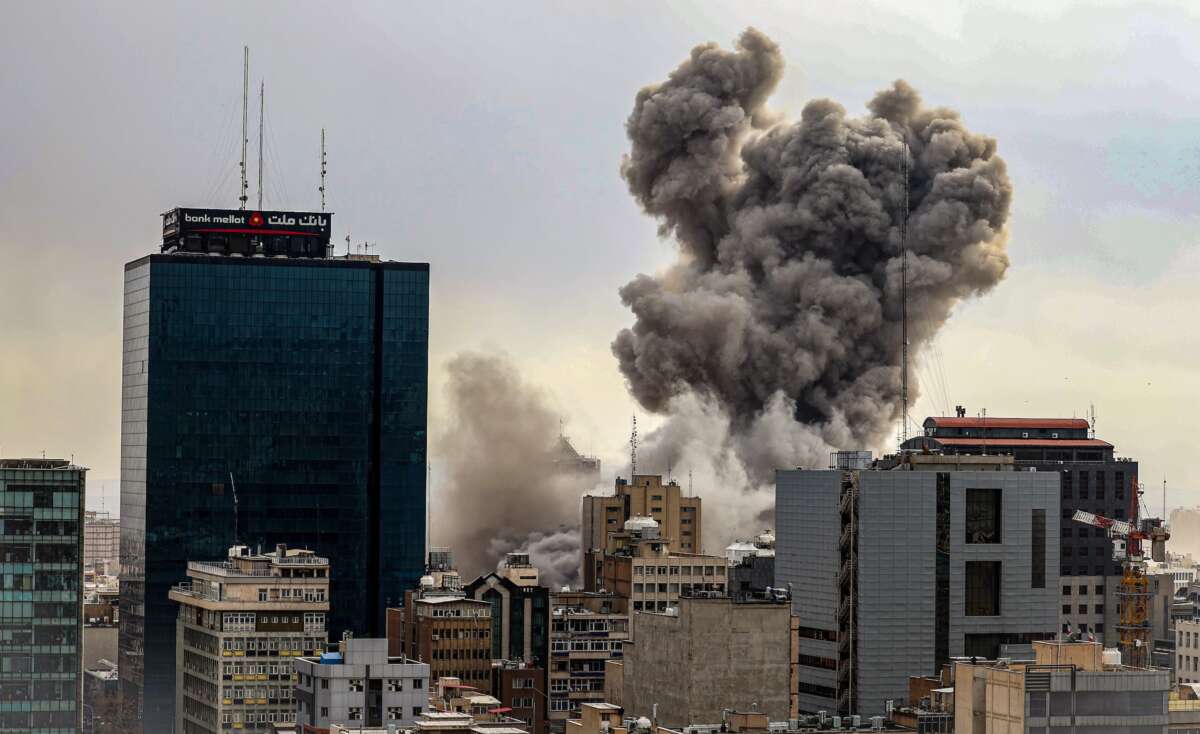
The death toll from United States and Israeli military strikes across Iran has risen to at least 555, according to the Iranian Red Crescent Society.

The humanitarian organization reported that bombardments have impacted a broad geographic area, with attacks recorded in 131 cities nationwide.
Emergency response teams continue operations in multiple provinces, focusing on rescue, relief, transfer, and medical services.
The Iranian Red Crescent Society stated that following enemy attacks in recent days, so far 131 cities have been involved in the incident.
The organization added that relief activities are continuing around the clock.
Iranian Red Crescent Society further noted that 555 compatriots were martyred, and rescue, relief, transfer, and medical services operations are being carried out continuously.
It also indicated that more than 100,000 rescue and relief workers have been placed on full alert to address the escalating humanitarian situation.
It was gathered that the increased casualty figure follows the death of Iran’s Supreme Leader, Ayatollah Ali Khamenei, in joint U.S.-Israeli strikes earlier in the conflict. Iran’s interim leadership has moved to consolidate authority.
Iran’s temporary leadership council held its second meeting late Sunday, March 1, 2026.
President Masoud Pezeshkian reaffirmed the government’s commitment to upholding the policies of the late leader.
Pezeshkian stated in a recorded video message following the session that the temporary leadership council started its work today and by God’s grace and power will continue the path of the late imam and the dear martyred leader and the path of all truth-seekers in the world.
In his remarks, the president issued a strong warning to Washington and Tel Aviv, asserting that the killing of Iran’s supreme leader would not weaken the nation.
Pezeshkian declared that America and the Israeli regime should know that martyring the supreme leader of the Islamic Revolution will bring them nothing but humiliation.
He called on citizens to show unity and solidarity during the national period of mourning and resistance.
Pezeshkian said that our dear nation is mourning this great martyr today, and all of us, with our presence on the scene and in the field, in mosques and streets, must thwart the enemies’ sinister plans with empathy and hand in hand.
He added that Iran’s armed forces remain prepared for any further confrontation.Pezeshkian stated that the armed forces of the Islamic Republic of Iran are ready and will be ready to crush the bases of enemies, and will disappoint enemies as always.
Background of the Ongoing US-Israel War Against Iran
The current conflict between the United States, Israel, and Iran escalated into direct warfare in late February 2026, building on decades of hostility.
Tensions trace back to the 1979 Iranian Revolution, which ended U.S. support for the Shah and established an anti-Western Islamic Republic under Ayatollah Ruhollah Khomeini.
Iran labeled the U.S. the “Great Satan” and Israel the “Little Satan,” while supporting proxy militias like Hezbollah, Hamas, and groups in Iraq, Syria, and Yemen that targeted U.S. and Israeli interests.
Key escalations included Iran’s nuclear program, suspected of weapons development despite Tehran’s denials. The 2015 JCPOA nuclear deal limited Iran’s activities in exchange for sanctions relief, but the U.S. withdrew in 2018 under President Trump, reimposing “maximum pressure” sanctions.
Iran responded by breaching enrichment limits and advancing centrifuge technology.Proxy wars intensified: Israel conducted hundreds of airstrikes on Iranian-linked targets in Syria since 2011 to disrupt arms flows to Hezbollah.
Iran-backed attacks included the 2019 drone strikes on Saudi oil facilities and Houthi disruptions in the Red Sea. The 2020 U.S. killing of IRGC General Qasem Soleimani prompted Iranian missile strikes on U.S. bases in Iraq.
By 2025, Iran’s nuclear advancements and regional aggression prompted renewed U.S.-Israeli coordination.
Israel launched preemptive strikes in late 2025 on nuclear sites, followed by U.S. involvement in early 2026 under renewed Trump administration policies emphasizing regime change and prevention of Iranian nuclear weapons.
The war formally began on February 28, 2026, with joint U.S.-Israeli operations (Operation Epic Fury/Roaring Lion) targeting Iranian nuclear facilities, missile sites, IRGC bases, and leadership.
A major strike killed Supreme Leader Ayatollah Ali Khamenei in Tehran, along with senior officials and family members.
Iran retaliated with ballistic missiles and drones against Israel, U.S. bases in the Gulf, and allies like the UAE and Qatar.As of March 3, 2026, the conflict has entered its fifth day, with ongoing airstrikes, missile exchanges, and proxy involvement (e.g., Hezbollah in Lebanon).
No ceasefire holds, and the U.S. has signaled a prolonged campaign.