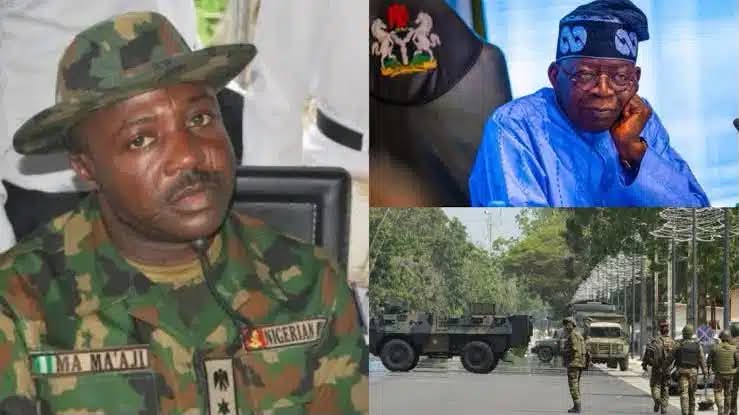
Mohammed Ma’aji, the Nigerian Army colonel accused of leading an alleged plot to overthrow President Bola Ahmed Tinubu’s government, has said his actions were driven by patriotism and concerns about Nigeria’s worsening condition rather than personal ambition.
Ma’aji said economic hardship, poor governance and the declining welfare of Nigerians and military personnel were among the issues that influenced his decision.
According to Premium Times, Ma’aji said the alleged action had a long history and was motivated by his love for the country and his profession.
He said he and others had concerns about what he described as Nigeria’s gradual decline, warning that the country was approaching a point of collapse.
The colonel also linked his concerns to the difficulty of providing for his five children on his salary, saying his personal experience had deepened his worries about the country.
Ma’aji said he attended Army Day Secondary School but questioned how many Nigerians could afford to send their children to such schools due to what he attributed to bad governance.
He further raised concerns about the welfare of military personnel, particularly officers and soldiers who sustained injuries during combat operations.
Ma’aji alleged that some wounded soldiers receiving treatment at the 44 Nigerian Army Reference Hospital in Kaduna were not getting adequate care, describing their experience as a reflection of wider challenges within the armed forces.
According to him, the concerns over the country’s condition and military welfare strengthened his conviction that immediate measures were needed to alter Nigeria’s direction.
He said the alleged action was driven by a desire to have a prosperous nation that Nigerians could be proud of, adding that he became worried that the country might not survive if nothing was done.
Ma’aji said the alleged plot was still at the mobilisation stage, with plans to recruit officers who shared similar concerns, when he was arrested.
He described Nigeria as turning into a “banana republic” and said the country was on what he considered a dangerous trajectory.
The colonel said the plan was to recruit enough like-minded officers and soldiers who could participate, adding that the team had not been fully formed because further meetings were still expected to take place.
He said there was no fixed date for the alleged operation as the group was waiting for resources and the involvement of more officers and soldiers.
Ma’aji said he personally financed a significant portion of the alleged operation, while Timipre Silva was said to have contributed about N400 million.
He denied any foreign involvement and said the group had not settled on a date to execute the alleged operation.
Ma’aji also denied reaching out to some senior military officers, but attributed the resurgence of the alleged movement to dissatisfaction among soldiers and his unsuccessful attempts at securing promotion.
He called for the establishment of a formal mechanism through which military officers could communicate their grievances to Waidi Shaibu, Chief of Army Staff, without fear of victimisation.
Among his recommendations were better remuneration and welfare packages for military personnel, improved pension benefits, greater access to education and stronger measures to address corruption in Nigeria and the armed forces.
The colonel also faulted the removal of the fuel subsidy, arguing that the policy should have been discontinued gradually.
Following his arrest and subsequent interaction with the panel investigating the alleged plot, Ma’aji appealed to the authorities for leniency, saying he had reconsidered his approach.
He said the experience had changed his mindset and insisted that the alleged action was not intended to destabilise the country.
Ma’aji appealed for pardon, describing himself and others involved as first offenders and saying they had no other country or job.
He maintained that the alleged plans were motivated by patriotism, love of country and the desire to have a prosperous Nigeria that Nigerians could be proud of.
The alleged coup plot was uncovered in late September 2025, leading to the cancellation of the October 1 Independence Day parade and changes in the military leadership, including the removal of Christopher Musa as Chief of Army Staff.